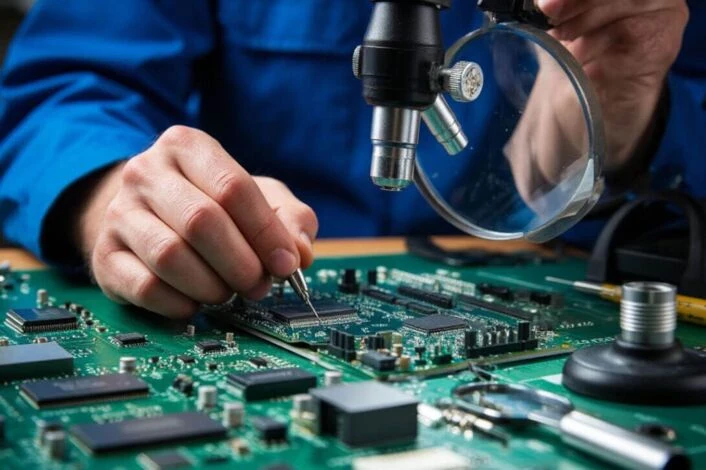




Electronic Board and Control Module Repair in Gyumri
Control boards are used in appliances, heating and cooling equipment, power supplies, automation systems and industrial machines. A device that will not start or displays an error does not automatically have a failed board: sensors, wiring, motors, power input and other components can create similar symptoms. On Turn.am, you can compare independent board-repair providers serving Gyumri and contact them directly.
Confirm whether the board is actually the fault
Before removing a module, record the equipment make, exact model, serial information, error code and sequence of events. Mention voltage events, moisture, overheating, previous repairs and any parts already replaced. If another technician diagnosed the board, send their measurements or written conclusion rather than only saying “the board is burnt.”
Some faults can be diagnosed only in the complete machine because the module depends on sensors, loads, communication lines or configuration. Ask whether the provider tests boards independently, visits the equipment or works with an appliance, HVAC or industrial technician for system-level checks.
Boards that may be accepted for repair
- appliance power and control boards;
- heating, ventilation and air-conditioning controllers;
- power-supply and inverter assemblies;
- motor-control and drive electronics;
- industrial automation and interface modules;
- display, relay and input-output boards.
Acceptance depends on the provider’s specialization, available schematics or test equipment, damage level and component availability. Automotive, safety-critical, medical or security-related modules may require different expertise and validation, so identify the exact application.
Safe removal and transport
Electronic assemblies may contain hazardous stored energy or be connected to mains voltage. Do not open powered equipment or remove a board unless you are competent to isolate it safely. For some appliances, a qualified service technician should remove and reinstall the module.
Protect a removed board against static discharge, impact, moisture and bent connectors. Do not wrap it directly in ordinary plastic or place loose screws on it. Label every plug only if this can be done without creating a wiring error, and send related cables, displays or power sections only when requested.
What diagnosis may include
Bench diagnosis may begin with visual inspection for contamination, corrosion, damaged tracks, overheated parts, poor solder joints and previous modifications. The technician may then assess supply rails, short circuits, semiconductors, relays, capacitors, communication or other functions relevant to the design.
A visibly damaged component may be the consequence rather than the original cause. For example, an external load or supply problem can damage a repaired board again after installation. Ask whether the suspected external cause has been identified and what must be checked before reconnection.
When repair may not be practical
Repair may be limited by a damaged processor, unavailable programmed component, extensive carbonization, severe corrosion, missing information or inability to reproduce operating conditions. Previous uncontrolled work can also remove pads or tracks and make the outcome uncertain. A responsible provider should explain these limits before continuing.
Compare repair with a compatible replacement, considering part identity, hardware revision, firmware, configuration, programming and installation. A physically similar module may not be interchangeable. Keep the original until compatibility and successful operation are confirmed.
Estimate, parts and approval
Pricing may include intake diagnosis, component-level repair, donor parts, programming, bench testing and return diagnosis if the module fails in the equipment. Ask whether diagnosis is charged when repair is declined or impossible and whether the estimate is fixed or may change after hidden damage is found.
Agree on the maximum approved amount, replacement-part policy and treatment of the old components. For rare or high-cost parts, ask whether they are new, recovered or supplied by the customer. Do not uate two offers as equal if one includes only soldering while another includes diagnosis and functional testing.
Testing and warranty boundaries
Ask how the repaired functions will be tested and whether the provider has a fixture, compatible unit or only limited bench checks. Final verification in the original equipment may still be necessary. Confirm who installs the module and checks external loads, wiring, supply and cooling before power is applied.
The handover should identify the diagnosed fault, work performed, major parts replaced, test scope and remaining limitations. Warranty terms should state what is covered and whether damage caused by an unresolved external fault, moisture, voltage event or incorrect installation is excluded.
Find board-repair specialists in Gyumri
View electronic board and control-module repair listings on Turn.am and contact suitable independent providers directly. Turn.am does not perform diagnosis or repair and does not set the provider’s price, timeframe or warranty.