












Engine Oil Change Services
A proper oil change starts with the engine manufacturer’s requirements, not simply a familiar brand. Viscosity, performance classification, manufacturer approval and fill quantity all matter. The service should also use the correct filter, verify the final level and check for fresh leakage. Armenian listings may describe an oil-change point as yuxman ket.
Turn.am lists independent oil-change centres and vehicle workshops. You can review their published services and contact them directly. Turn.am does not change oil, sell lubricants or determine which product is suitable for a vehicle.
Engine oil is not the same as every vehicle fluid
This category mainly concerns engine oil. Transmission, differential, steering and other system fluids have separate specifications and service procedures. If you need one of those services, identify the exact unit and confirm that the provider offers the appropriate work.
Some packages may add air, fuel or cabin-filter replacement, a visual inspection or fluid-level checks. Do not assume these are included in every oil change; ask which items are standard and which create an additional charge.
Identify the required oil specification
Use the vehicle owner’s manual and current manufacturer requirements as the starting point. Different engines within the same model range may specify different SAE viscosity, API or ACEA performance and manufacturer approvals. “Synthetic,” “semi-synthetic” or a brand name alone does not identify the complete requirement.
Provide the make, model, year, engine variant and, when needed for exact identification, the VIN. Before filling, ask to see the container label or the exact product and specification used from bulk storage. If a proposed oil differs from the manual, request a compatibility basis rather than accepting it because of price or viscosity alone.
Follow the vehicle’s service interval
The applicable interval comes from the owner’s manual or onboard maintenance system. It may account for engine type, oil, elapsed time, mileage and operating conditions. One mileage figure is not correct for every vehicle, and oil colour alone does not establish that service can be delayed.
A maintenance reminder is different from a low oil-pressure warning. If an oil-pressure warning appears while the engine is running, stop safely and switch off the engine in accordance with the vehicle manual. Adding oil or resetting a message does not prove that an underlying pressure problem has been resolved.
Information to provide before booking
Send the vehicle and engine details, current mileage, last service date and previous oil if known. Mention dashboard warnings, leakage, falling oil level, smoke or unusual engine behaviour. These signs may require separate assessment because a routine oil change is not a repair for an unidentified fault.
- Confirm the full oil specification and required quantity.
- Ask for the filter brand or part number.
- Check whether a new drain-plug washer or seal is included.
- Agree whether you or the workshop supplies the materials.
- Separate material, labour and additional inspection charges.
If supplying your own oil, send a photograph of the packaging first and confirm that the workshop accepts customer-provided materials. Ask how this affects responsibility for the service.
What the procedure should cover
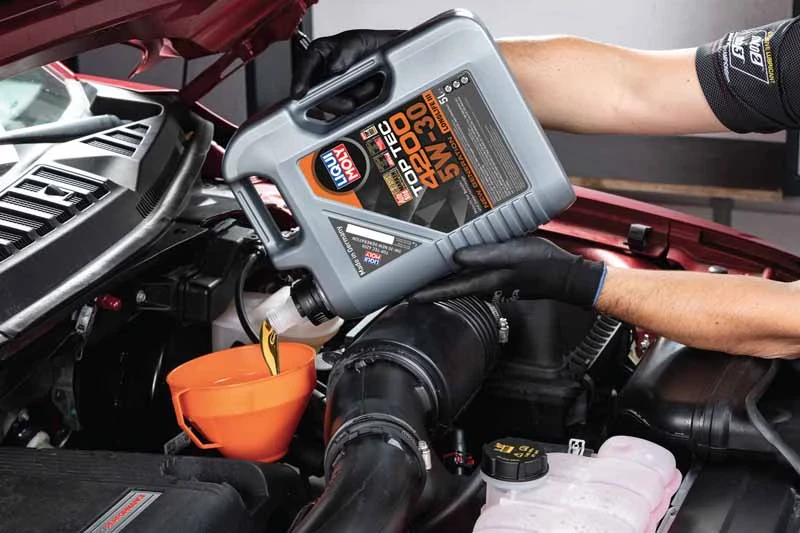
The workshop should confirm the vehicle, materials and visible leakage before starting. Old oil is removed using a method appropriate for that vehicle, the correct filter and sealing item are installed, and oil of the required specification is added without overfilling.
After starting, the pressure indicator, filter area and drain plug are checked, followed by a final level check under the manufacturer’s stated conditions. Removed underbody panels need secure refitting. The service reminder should be reset only after the work is recorded, and electronic level measurement should follow the vehicle procedure.
Flushes, additives and extra recommendations
Engine flushing and oil additives are not mandatory parts of every oil change. If suggested, ask about their purpose, compatibility and the vehicle manufacturer’s guidance. Flushing an engine with an unresolved problem or using thicker oil to mask a symptom is not a substitute for diagnosis.
Visible particles, pale emulsion, a strong fuel smell, substantial leakage or rapid oil loss warrant separate investigation. The provider should distinguish routine maintenance from fault-finding and obtain approval before additional work.
Compare the complete price
Cost depends on oil specification and quantity, filter, seals, service method and access on the particular vehicle. Compare quotations using the same specification and filter. A low headline price may exclude the filter, labour or part of the required fill quantity.
Before paying, obtain the oil name and specification, quantity filled, filter details, mileage and service date. If leakage or another concern was found, ask for it to be recorded separately without automatically authorising an unrelated repair.
Checks before leaving
Confirm that the level was checked using the prescribed method, no oil-pressure warning remains, and no fresh oil is visible near the filter, drain point or beneath the vehicle. Check that the engine undertray is secure and retain the receipt and product details for the next service.
Ask how the workshop handles used oil and filters. They should not be poured onto land, into drains or placed with ordinary waste; appropriate local collection or recycling arrangements are required.
Browse engine oil change services on Turn.am and send suitable providers the exact vehicle and engine details.